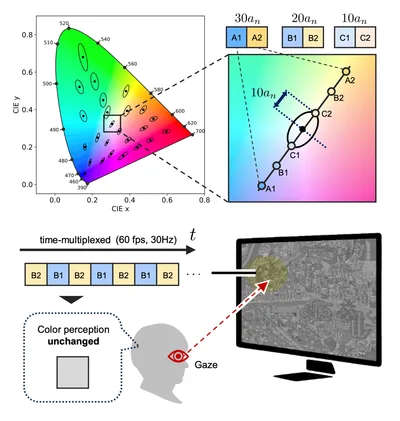
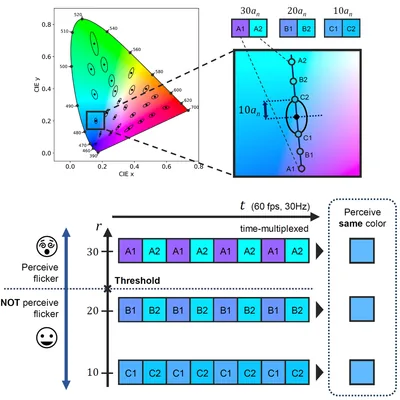
We study rapid color alternation that appears as a stable color, examining how color pairs, modulation direction, and amplitude affect perception. We apply these findings to embedding information in visual content and guiding gaze.
Related publications (4)
2025
IEEE TVCG
J10 ChromaGazer: Unobtrusive Visual Modulation using Imperceptible Color Vibration for Visual Guidance
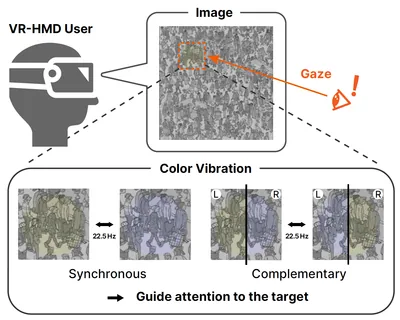
Visual guidance (VG) plays an essential role in directing user attention in virtual reality (VR) and augmented reality (AR) environments. However, traditional approaches rely on explicit visual annotations, which often compromise visual clarity and increase user cognitive load. To address this issue, we propose an unobtrusive VG technique based on color vibration, a phenomenon in which rapidly alternating colors at frequencies above 25 Hz are perceived as a single intermediate color. Our work explores a perceptual state that exists between complete color fusion and visible flicker, where color differences remain detectable without conscious awareness of vibration. Through two experimental studies, we first identified the thresholds separating complete fusion, this intermediate perceptual state, and visible flicker by systematically varying color vibration parameters. Subsequently, we applied color vibrations with derived thresholds to natural image regions and validated their attention-guiding capabilities using eye-tracking measurements. The results demonstrate that controlled color vibration successfully directs user attention while maintaining low cognitive demand, providing an effective method for implementing unobtrusive VG in VR and AR systems.
@article{tosa2025chromagazer,month=mar,author={Tosa, Rinto and Hattori, Shingo and Hiroi, Yuichi and Itoh, Yuta and Hiraki, Takefumi},journal={IEEE Transactions on Visualization and Computer Graphics},title={ChromaGazer: Unobtrusive Visual Modulation using Imperceptible Color Vibration for Visual Guidance},year={2025},volume={31},number={5},pages={3450-3458},keywords={Visual Guidance;Imperceptible Color Vibration;Color Perception;Augmented Reality},doi={10.1109/TVCG.2025.3549173}}
Augmented Humans
CF11 ChromaGazer-HMD: Visual Modulation using Unobtrusive Color Vibration for Gaze Guidance with Head-Mounted Displays
VR content often involves vast spaces for users to explore, making it uncertain whether they will notice areas or objects highlighted by content creators. While various methods for guiding users’ gaze have been proposed, those that significantly alter the appearance of the content can reduce its naturalness and negatively impact the user experience. In this study, we explored a Visual Guidance (VG) approach using color vibration, based on the human visual system’s inability to perceive rapid chromatic changes. We evaluated its applicability to HMD environments and introduced a method called complementary color vibration, where opposite-phase vibrations are applied to the left and right displays of the HMD. We further investigated optimal parameters for VG and assessed its effectiveness in search tasks. Our experiments revealed that color vibration in HMD environments significantly reduced search times and areas compared to conditions without guidance, while maintaining the naturalness of the content. Furthermore, complementary color vibration was found to preserve naturalness significantly better than conventional synchronous color vibration. These findings indicate that VG using color vibration is effective in HMD environments and that complementary color vibration is less obtrusive than traditional synchronous color vibration.
@inproceedings{shen2025chromagazerhmd,author={Shen, Youfang and Tosa, Rinto and Hatada, Yuji and Hiroi, Yuichi and Hiraki, Takefumi and Naemura, Takeshi},title={ChromaGazer-HMD: Visual Modulation using Unobtrusive Color Vibration for Gaze Guidance with Head-Mounted Displays},year={2025},isbn={9798400715662},publisher={Association for Computing Machinery},address={New York, NY, USA},doi={10.1145/3745900.3746090},booktitle={Proceedings of the Augmented Humans International Conference 2025},pages={43–54},numpages={12},month=mar,}
2024
IEEE TVCG
J8 HaptoFloater: Visuo-Haptic Augmented Reality by Embedding Imperceptible Color Vibration Signals for Tactile Display Control in a Mid-Air Image
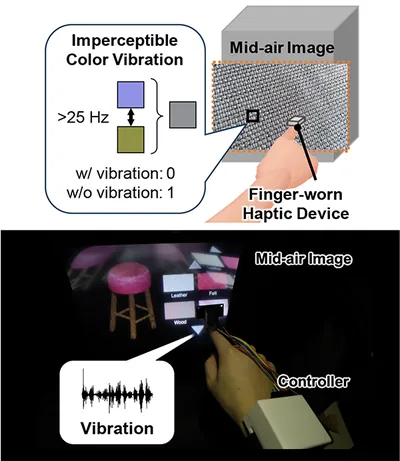
We propose HaptoFloater, a low-latency mid-air visuo-haptic augmented reality (VHAR) system that utilizes imperceptible color vibrations. When adding tactile stimuli to the visual information of a mid-air image, the user should not perceive the latency between the tactile and visual information. However, conventional tactile presentation methods for mid-air images, based on camera-detected fingertip positioning, introduce latency due to image processing and communication. To mitigate this latency, we use a color vibration technique; humans cannot perceive the vibration when the display alternates between two different color stimuli at a frequency of 25 Hz or higher. In our system, we embed this imperceptible color vibration into the mid-air image formed by a micromirror array plate, and a photodiode on the fingertip device directly detects this color vibration to provide tactile stimulation. Thus, our system allows for the tactile perception of multiple patterns on a mid-air image in 59.5 ms. In addition, we evaluate the visual-haptic delay tolerance on a mid-air display using our VHAR system and a tactile actuator with a single pattern and faster response time. The results of our user study indicate a visual-haptic delay tolerance of 110.6 ms, which is considerably larger than the latency associated with systems using multiple tactile patterns.
@article{nagano2024haptofloater,author={Nagano, Rina and Kinoshita, Takahiro and Hattori, Shingo and Hiroi, Yuichi and Itoh, Yuta and Hiraki, Takefumi},journal={IEEE Transactions on Visualization and Computer Graphics},title={HaptoFloater: Visuo-Haptic Augmented Reality by Embedding Imperceptible Color Vibration Signals for Tactile Display Control in a Mid-Air Image},year={2024},volume={30},number={11},pages={7463-7472},keywords={Haptic interfaces;Vibrations;Visualization;Image color analysis;Actuators;Delays;Tactile sensors;Visuo-haptic displays;mid-air images;LCD displays;imperceptible color vibration},doi={10.1109/TVCG.2024.3456175},issn={1941-0506},month=nov,}
SIGGRAPH Poster
CP9 Measurement of the Imperceptible Threshold for Color Vibration Pairs Selected by using MacAdam Ellipse
We propose an efficient method for searching for color vibration pairs that are imperceptible to the human eye based on the MacAdam ellipse, an experimentally determined color-difference range that is indistinguishable to the human eye. We created color pairs by selecting eight colors within the sRGB color space specified by the ellipse, and conducted experiments to confirm the threshold of the amplitude of color vibration amplitude at which flicker becomes imperceptible to the human eye. The experimental results indicate a general guideline for acceptable amplitudes for pair selection.
@inproceedings{hattori2024macadam,pages={1--2},month=jul,author={Hattori, Shingo and Hiroi, Yuichi and Hiraki, Takefumi},title={Measurement of the Imperceptible Threshold for Color Vibration Pairs Selected by using MacAdam Ellipse},year={2024},isbn={9798400705168},publisher={Association for Computing Machinery},address={New York, NY, USA},url={https://doi.org/10.1145/3641234.3671041},doi={10.1145/3641234.3671041},booktitle={ACM SIGGRAPH 2024 Posters},articleno={68},numpages={2},keywords={MacAdam ellipse, color perception, imperceptible color vibration},location={Denver, CO, USA},series={SIGGRAPH '24},}