As metaverse platforms evolve into social and commercial spaces, companies increasingly host virtual events to enhance brand awareness and customer engagement. However, how participation in such events translates into real-world outcomes—specifically, increased intention to visit physical stores—remains underexplored. We analyzed behavioral logs and survey responses from 814 participants at "Metaverse AEON," a month-long commercial event on the Cluster platform. Six behavioral metrics were compared between users who reported increased store visit intention and those who reported no change. Results suggest that active engagement—game play, photography, emote use, and revisits—was significantly associated with increased visit intention, while dwell time alone showed inconsistent effects. Moreover, these association patterns varied by user segment: Virtual YouTuber fans showed positive associations across multiple metrics, whereas non-fans responded mainly to general-audience content. These findings suggest that engagement quality may play a key role in the transfer from virtual events to real-world behavioral intentions, offering design implications for metaverse brand experiences.
@inproceedings{tokida2026analyze-aeon,author={Tokida, Satomi and Hiroi, Yuichi and Uesugi, Miyabi and Shimono, Atsushi and Suzuki, Haruyuki and Abe, Shouma and Hiraki, Takefumi},title={Analyzing User Behaviors in Metaverse Brand Events that Drive Real-World Store Visit Intentions},booktitle={2026 IEEE Conference on Virtual Reality and 3D User Interfaces Abstracts and Workshops (VRW)},year={2026},doi={10.1109/VRW70859.2026.00138},volume={},number={},pages={714--717},month=mar,}
IEEE VR Workshop
CW8 Verselyzer: A Statistical Analysis Interface Enabling Non-Experts to Assess Metaverse Branding Effectiveness
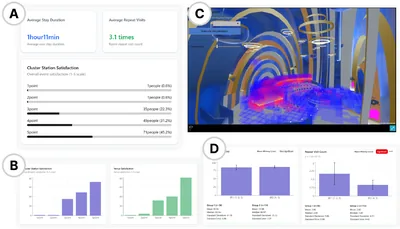
Branding in metaverse spaces offers significant potential for immersive customer engagement through embodied, physical-world-like interactions. However, unlike traditional web-based marketing, metaverse branding involves users’ active, spatial behaviors, requiring different KPI design and evaluation methods that remain underexplored. To address this gap, we propose "Verselyzer," a web interface that enables non-experts to design KPIs and evaluate branding effectiveness in metaverse environments. Based on a formative study with seven branding practitioners, we derived design requirements emphasizing (1) metaverse-specific behavioral data collection and (2) accessible analysis support for non-experts. The resulting system progressively supports hypothesis formulation, data visualization, spatial behavior comprehension, and simplified statistical analysis. A user study with 11 practitioners demonstrated that Verselyzer effectively supports hypothesis verification, while also revealing that statistical tools can uncover hidden insights and help formalize experience-based hypotheses. These findings provide practical implications for improving metaverse branding practices as commercial use of virtual spaces continues to grow.
@inproceedings{yokoi2026verselyzer,author={Yokoi, Sotaro and Tokida, Satomi and Hiroi, Yuichi and Hiraki, Takefumi},title={Verselyzer: A Statistical Analysis Interface Enabling Non-Experts to Assess Metaverse Branding Effectiveness},booktitle={2026 IEEE Conference on Virtual Reality and 3D User Interfaces Abstracts and Workshops (VRW)},year={2026},doi={10.1109/VRW70859.2026.00134},volume={},number={},pages={692--695},month=mar,}
2025
IEEE ISEMV
CF16 Community Analysis of Social Virtual Reality Based on Large-Scale Log Data of a Commercial Metaverse Platform
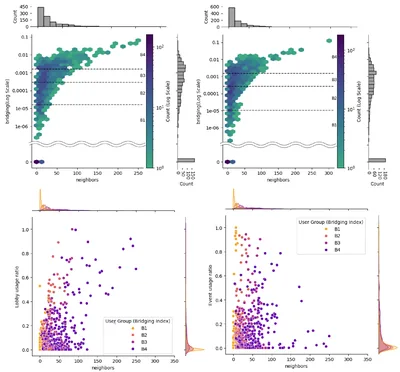
This study quantitatively analyzes the structural characteristics of user communities within Social Virtual Reality (Social VR) platforms supporting head-mounted displays (HMDs), based on large-scale log data. By detecting and evaluating community structures from data on substantial interactions (defined as prolonged co-presence in the same virtual space), we found that Social VR platforms tend to host numerous, relatively small communities characterized by strong internal cohesion and limited inter-community connections. This finding contrasts with the large-scale, broadly connected community structures typically observed in conventional Social Networking Services (SNS). Furthermore, we identified a user segment capable of mediating between communities, despite these users not necessarily having numerous direct connections. We term this user segment ‘community hoppers’ and discuss their characteristics. These findings contribute to a deeper understanding of the community structures that emerge within the unique communication environment of Social VR and the roles users play within them.
@inproceedings{tsutsui2025communityanalysis,title={Community Analysis of Social Virtual Reality Based on Large-Scale Log Data of a Commercial Metaverse Platform},author={Tsutsui, Hiroto and Hiraki, Takefumi and Hiroi, Yuichi and Hasegawa, Shoichi},year={2025},booktitle={Proceedings of 2025 IEEE International Symposium on Emergence Metaverse},month=oct,pages={95-103},doi={10.1109/ISEMV67326.2025.00026},}