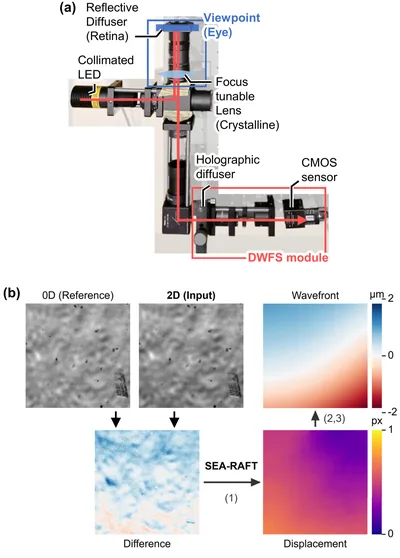
Focus-adaptive near-eye displays counter the vergence–accommodation conflict by matching focus to the viewer’s eye, which requires measuring the eye’s refractive state. Clinical aberrometers are too large and slow for a headset, and compact wavefront sensors trade away range and accuracy. Diffuser-based wavefront sensing (DWFS) is a compact, wide-range alternative in which a thin diffuser makes a bare image sensor a refraction sensor, since the caustic speckle it casts shifts with refractive error. Estimating that shift field fast enough has been the bottleneck. We recast the DWFS analysis as a differentiable, GPU-resident back-end and show that a pre-trained optical-flow network, SEA-RAFT, applied zero-shot without fine-tuning on caustics, can drive it in place of the slow registration. With a compact three-parameter per-device calibration it reaches a mean absolute error of 0.093 D against the nominal lens diopter, about 2.7 times inside the 0.25 D clinical tolerance, and a compressed configuration runs at 13 ms and 75 Hz at 0.075 D, the rate a focus-adaptive display needs.
@inproceedings{fujimoto2026realtimedwfs,author={Fujimoto, Futa and Hiroi, Yuichi and Itoh, Yuta},title={Real-Time, Training-Free Ocular Refraction Sensing with a Thin Diffuser for Near-Eye Displays},booktitle={Proceedings of the 32nd ACM Symposium on Virtual Reality Software and Technology},series={VRST '26},publisher={Association for Computing Machinery},year={2026},month=nov,pages={1--2},doi={10.1145/3822517.3849910},}
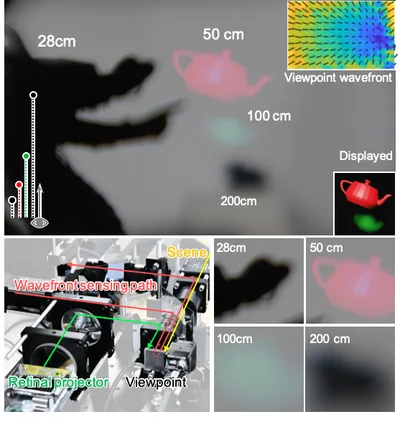
The primary challenge in optical see-through near-eye displays lies in providing correct optical focus cues. Established approaches such as varifocal or light field display essentially sacrifice temporal or spatial resolution of the resulting 3D images. This paper explores a new direction to address the trade-off by combining a retinal projection display (RPD) with ocular wavefront sensing (OWS). Our core idea is to display a depth of field-simulated image on an RPD to produce visually consistent optical focus cues while maintaining the spatial and temporal resolution of the image. To obtain the current accommodation of the eye, we integrate OWS. We demonstrate that our proof-of-concept system successfully renders virtual contents with proper depth cues while covering the eye accommodation range from 28.5 cm (3.5 D) to infinity (0.0 D).
@inproceedings{kaneko2021focusaware,author={Kaneko, Mayu and Hiroi, Yuichi and Itoh, Yuta},booktitle={2021 IEEE International Symposium on Mixed and Augmented Reality Adjunct (ISMAR-Adjunct)},title={Focus-Aware Retinal Projection-based Near-Eye Display},year={2021},volume={},number={},pages={207-208},keywords={Three-dimensional displays;Optical variables measurement;Optical imaging;Retina;Rendering (computer graphics);Adaptive optics;Light fields;Augmented reality;accommodation sensing;retinal projection;near-eye display},doi={10.1109/ISMAR-Adjunct54149.2021.00049},issn={},month=oct,}