Beaming Displays
映像を投影する光学系を環境側に置き、身につける眼鏡を軽くするディスプレイを研究しています。高速な追跡・投影制御、複数プロジェクタの協調、薄型の導波路光学系の設計を通じて、頭の動きに追従する映像提示を探ります。
関連論文 (7)
2026
- IEEE TVCG
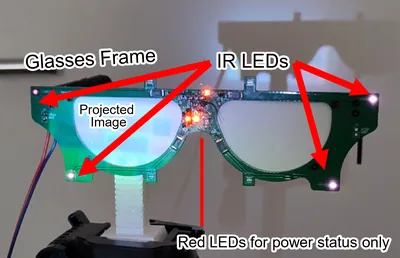 J15 BeamStellar: Beaming Display with Low-Latency, 6-DoF Glasses Tracking via Spatio-Temporal LED EncodingJonas Weigand, Christian Eichhorn, Yuichi Hiroi, and Yuta ItohIEEE Transactions on Visualization and Computer Graphics, Mar 2026
Conventional Augmented Reality (AR) head-mounted displays (HMDs) integrate all essential components within the wearable unit, imposing limitations on weight, heat dissipation, and battery life. Beaming Displays (BDs) address these constraints by externalizing computation and projection; however, achieving reliable low-latency six-degrees-of-freedom (6-DoF) tracking remains a challenge. We present BeamStellar, a BD system that enables low-latency 6-DoF head tracking by combining a position-sensitive detector (PSD) with a spatio-temporally modulated infrared LED array mounted on passive glasses. The system integrates tracking and projection via a co-aligned optical path and performs real-time signal processing on an FPGA to minimize tracking latency. We describe the system architecture, pose reconstruction pipeline, and evaluate the pose-tracking latency of approximately 430 µs. BeamStellar provides a replicable, lightweight AR tracking platform, establishing a new paradigm for low-latency environment-based AR systems.
@article{weigand2026stellar,
  author = {Weigand, Jonas and Eichhorn, Christian and Hiroi, Yuichi and Itoh, Yuta},
  title = {BeamStellar: Beaming Display with Low-Latency, 6-DoF Glasses Tracking via Spatio-Temporal LED Encoding},
  journal = {IEEE Transactions on Visualization and Computer Graphics},
  year = {2026},
  volume = {32},
  number = {5},
  pages = {3222-3228},
  doi = {10.1109/TVCG.2026.3680746},
  month = mar,
}
2025
- IEEE VR
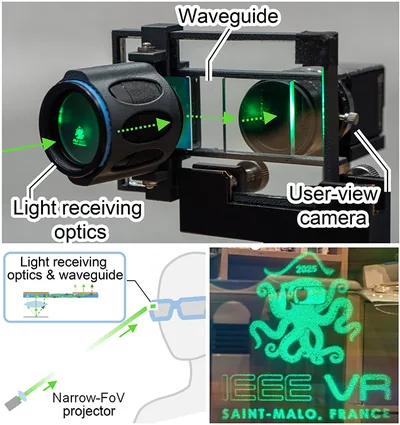 CF10 Slim Diffractive Waveguide Glasses for Beaming Displays with Enhanced Head Orientation ToleranceIn 2025 IEEE Conference on Virtual Reality and 3D User Interfaces (IEEE VR), Mar 2025
Augmented Reality (AR) glasses must be slim, lightweight, and energy-efficient to achieve widespread adoption. Beaming Displays present a promising solution by offloading active components, such as the power-supplied light engine, into the surrounding environment while leaving only passive elements, like the eyepiece, in the wearable device. However, existing approaches still struggle to achieve both a slim design and a wide tolerance for projection angles relative to the user’s head orientation. In this work, we introduce a design for light-receiving glasses using a diffractive waveguide with in-coupling and out-coupling gratings. Our approach expands the allowable range of incident angles while maintaining a compact, lightweight form factor. We developed a proof-of-concept prototype and demonstrated an incident angle tolerance of approximately 20-30 degrees range, overcoming the previous design of 5 degrees.
@inproceedings{itoh2025hoebeaming, author = {Itoh, Yuta and Nakamura, Tomoya and Hiroi, Yuichi and Aksit, Kaan}, title = {Slim Diffractive Waveguide Glasses for Beaming Displays with Enhanced Head Orientation Tolerance}, booktitle = {2025 IEEE Conference on Virtual Reality and 3D User Interfaces (IEEE VR)}, year = {2025}, volume = {}, number = {}, pages = {351-358}, keywords = {beaming display; augmented reality; waveguide; near-eye displays; DOEs}, month = mar, doi = {10.1109/VR59515.2025.00059}, } - IEEE VR Workshop
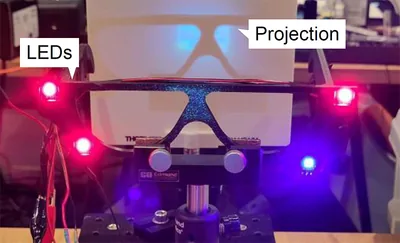 CW4 BeamStellar: Low-Latency, 6-DoF Head Tracking for Beaming Displays with Spatio-Temporal LED EncodingJonas Weigand, Yuichi Hiroi, and Yuta ItohIn 2025 IEEE Conference on Virtual Reality and 3D User Interfaces Abstracts and Workshops (VRW), Mar 2025
Conventional augmented reality (AR) head-mounted displays (HMDs) require the integration of all components, including optics and processors, which presents significant barriers to practical implementation due to weight and heat generation concerns. While Beaming Displays address these challenges by offloading computing and projection functions to the environment, existing solutions leaving 6-degrees of freedom (6DoF) image projection with low motion-to-photon (M2P) latency. In this position paper, we introduce our trial BeamStellar, a Beaming Display system that integrates 6 DoF head tracking by combining spatio-temporally encoded LED patterns with a position-sensing detector. Through digital signal processing using an FPGA, the system aims a theoretical latency of less than 200 microseconds. This implementation alleviates the hardware burden on users, facilitating seamless AR experiences that seamlessly blend virtual content with the physical world.
@inproceedings{weigand2025stellar,
  author = {Weigand, Jonas and Hiroi, Yuichi and Itoh, Yuta},
  title = {BeamStellar: Low-Latency, 6-DoF Head Tracking for Beaming Displays with Spatio-Temporal LED Encoding},
  booktitle = {2025 IEEE Conference on Virtual Reality and 3D User Interfaces Abstracts and Workshops (VRW)},
  year = {2025},
  volume = {},
  number = {},
  pages = {884--886},
  keywords = {Beaming Displays;Optical See-through Display;Low latency head tracking;Spatio-temporal Light pattern},
  month = mar,
  doi = {10.1109/VRW66409.2025.00180},
}
2024
- IEEE TVCG
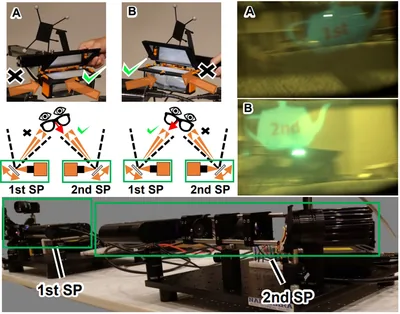 J7 Towards Co-Operative Beaming Displays: Dual Steering Projectors for Extended Projection Volume and Head Orientation RangeHiroto Aoki, Takumi Tochimoto, Yuichi Hiroi, and Yuta ItohIEEE Transactions on Visualization and Computer Graphics, May 2024Honorable Mention Best Paper Honorable Mention, IEEE VR 2024.
Existing near-eye displays (NEDs) have trade-offs related to size, weight, computational resources, battery life, and body temperature. A recent paradigm, beaming display, addresses these trade-offs by separating the NED into a steering projector (SP) for image presentation and a passive headset worn by the user. However, the beaming display has issues with the projection area of a single SP and has severe limitations on the head orientation and pose that the user can move. In this study, we distribute dual steering projectors in the scene to extend the head orientation and pose of the beaming display by coordinating the dual projections on a passive headset. For cooperative control of each SP, we define a geometric model of the SPs and propose a calibration and projection control method designed for multiple projectors. We present implementations of the system along with evaluations showing that the precision and delay are 1.8 ∼ 5.7 mm and 14.46 ms, respectively, at a distance of about 1 m from the SPs. From this result, our prototype with multiple SPs can project images in the projection area (20 \textmm \times 30 \textmm) of the passive headset while extending the projectable head orientation. Furthermore, as applications of cooperative control by multiple SPs, we show the possibility of multiple users, improving dynamic range and binocular presentation.
@article{aoki2024dualbeaming, author = {Aoki, Hiroto and Tochimoto, Takumi and Hiroi, Yuichi and Itoh, Yuta}, journal = {IEEE Transactions on Visualization and Computer Graphics}, title = {Towards Co-Operative Beaming Displays: Dual Steering Projectors for Extended Projection Volume and Head Orientation Range}, year = {2024}, volume = {30}, number = {5}, pages = {2309-2318}, keywords = {Mirrors;Cameras;Headphones;Calibration;Optical imaging;High-speed optical techniques;Head;Near-eye display;Augmented reality;Projectors}, doi = {10.1109/TVCG.2024.3372118}, issn = {1941-0506}, month = may, } - ISMAR Poster
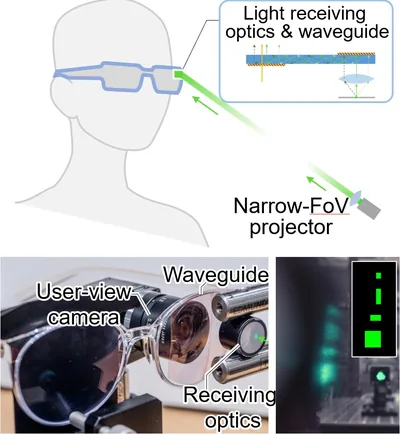 CP10 Beaming Display Using Thin Holographic Waveguides for Wider Head Orientation Angle RangeIn 2024 IEEE International Symposium on Mixed and Augmented Reality Adjunct (ISMAR-Adjunct), Oct 2024
Augmented Reality (AR) glasses face fundamental challenges related to technical trade-offs. Emerging Beaming Displays (BDs) offer a compelling solution by separating the active and passive components. However, existing BD-based AR glasses have yet to achieve a thin and lightweight design with wide incident projection angles. This work proposes an eyepiece for BDs, including a holographic waveguide with tailored in- and out-coupling gratings. The proposed design aims to achieve a millimeter-thin form factor with a wide tolerance for incident angles, thus overcoming the limitations of existing designs. We have constructed proof-of-concept passive AR glasses prototypes, all approximately 2mm thick, including one in the form of conventional eyeglasses, and demonstrated an acceptable lateral angle of incidence of up to 90 degrees.
@inproceedings{itoh2024thinholographic,
  author = {Itoh, Yuta and Nakamura, Tomoya and Hiroi, Yuichi and Aksit, Kaan},
  title = {Beaming Display Using Thin Holographic Waveguides for Wider Head Orientation Angle Range},
  booktitle = {2024 IEEE International Symposium on Mixed and Augmented Reality Adjunct (ISMAR-Adjunct)},
  year = {2024},
  volume = {},
  number = {},
  pages = {475-476},
  keywords = {Beaming display; Augmented reality; Near-eye display; waveguide; HOEs},
  doi = {10.1109/ISMAR-Adjunct64951.2024.00138},
  month = oct,
}
2023
- IEEE TVCG
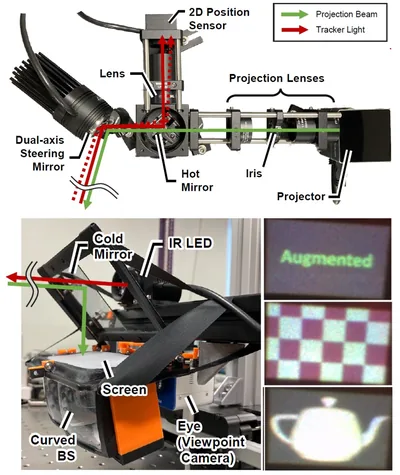 J5 Low-Latency Beaming Display: Implementation of Wearable, 133 μs Motion-to-Photon Latency Near-Eye DisplayYuichi Hiroi , Akira Watanabe, Yuri Mikawa, and Yuta ItohIEEE Transactions on Visualization and Computer Graphics, Nov 2023
This paper presents a low-latency Beaming Display system with a 133 μ\mathrms motion-to-photon (M2P) latency, the delay from head motion to the corresponding image motion. The Beaming Display represents a recent near-eye display paradigm that involves a steerable remote projector and a passive wearable headset. This system aims to overcome typical trade-offs of Optical See-Through Head-Mounted Displays (OST-HMDs), such as weight and computational resources. However, since the Beaming Display projects a small image onto a moving, distant viewpoint, M2P latency significantly affects displacement. To reduce M2P latency, we propose a low-latency Beaming Display system that can be modularized without relying on expensive high-speed devices. In our system, a 2D position sensor, which is placed coaxially on the projector, detects the light from the IR-LED on the headset and generates a differential signal for tracking. An analog closed-loop control of the steering mirror based on this signal continuously projects images onto the headset. We have implemented a proof-of-concept prototype, evaluated the latency and the augmented reality experience through a user-perspective camera, and discussed the limitations and potential improvements of the prototype.
@article{hiroi2023lowlatency, author = {Hiroi, Yuichi and Watanabe, Akira and Mikawa, Yuri and Itoh, Yuta}, journal = {IEEE Transactions on Visualization and Computer Graphics}, title = {Low-Latency Beaming Display: Implementation of Wearable, 133 μs Motion-to-Photon Latency Near-Eye Display}, year = {2023}, volume = {29}, number = {11}, pages = {4761-4771}, keywords = {Mirrors;Low latency communication;Headphones;Head;Cameras;Tracking;Two dimensional displays;Low-Latency Display;Beaming Display;Motion-to-Photon Latency;Lateral-effect Photodiodes}, doi = {10.1109/TVCG.2023.3320212}, issn = {1941-0506}, month = nov, } - ISMAR PosterCP8 Dual Beaming Display for Extended Head Orientation and Projection VolumeTakumi Tochimoto, Yuichi Hiroi, and Yuta ItohIn 2023 IEEE International Symposium on Mixed and Augmented Reality Adjunct (ISMAR-Adjunct), Oct 2023
Existing near-eye displays (NEDs) come with various tradeoffs, including size, weight, and battery life. The new "beaming display" model attempts to address these by splitting the NED into a steering projector (SP) and a passive headset. However, it has limitations in terms of projection area and user head movement. In this research, we utilize two steering projectors to expand the beaming display’s capabilities. We introduce a geometric model and a control method specifically for multiple projectors. Tests indicate an accuracy of 3-19mm and a delay of 14.46 ms from a 1m distance to the SPs, allowing projection onto a 20mm x 30mm area of the headset. This method not only expands head movement possibilities but also shows potential for multiple users and improved dynamic range and binocular presentation.
@inproceedings{tochimoto2023dualbeaming,
  author = {Tochimoto, Takumi and Hiroi, Yuichi and Itoh, Yuta},
  booktitle = {2023 IEEE International Symposium on Mixed and Augmented Reality Adjunct (ISMAR-Adjunct)},
  title = {Dual Beaming Display for Extended Head Orientation and Projection Volume},
  year = {2023},
  volume = {},
  number = {},
  pages = {377-378},
  keywords = {Headphones;Design methodology;Geometric modeling;Display systems;Focusing;Dynamic range;Delays;Human-centered computing;Visualization;Visualization techniques;Treemaps; Human-centered computing;Visualization design and evaluation methods},
  doi = {10.1109/ISMAR-Adjunct60411.2023.00081},
  issn = {2771-1110},
  month = oct,
}