Occlusion-Capable Displays
現実の光を部分的に遮り、バーチャルな物体が実物の手前にあるように見せる光学シースルーディスプレイを研究しています。焦点に応じた遮蔽のぼけや光に応答する材料の制御を通じて、自然な前後関係と見え方の実現を目指します。
関連論文 (9)
2026
- IEEE VR Workshop
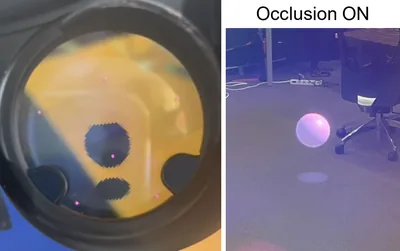 CW7 Depth Perception in Soft-Edge Occlusion-capable Optical See-through Head-mounted DisplaysIn 2026 IEEE Conference on Virtual Reality and 3D User Interfaces Abstracts and Workshops (VRW), Mar 2026
Commercial optical see-through head-mounted displays (OSTHMDs) are becoming increasingly prevalent. While conventional OST-HMDs use optical combiners to overlay virtual objects semitransparently onto the background, recent commercial products have introduced occlusion-capable OST-HMDs (OCOST-HMDs) that selectively block background light using occlusion masks. However, the depth perception characteristics of OCOST-HMDs, particularly the effect of occlusion on depth perception, remain insufficiently investigated. This study evaluated the effect of soft-edge occlusion masks on distance perception accuracy for virtual objects using Magic Leap 2, a commercial OCOST-HMD. We measured participants’ distance estimates while varying the presentation distance, vertical position, presence of drop shadows, and occlusion state of virtual objects. Our preliminary results confirmed that vertical position significantly affects distance perception, consistent with prior work. However, occlusion alone did not significantly improve distance estimation accuracy. These findings suggest that background occlusion for isolated objects provides limited effectiveness as a depth cue.
@inproceedings{gauthier2026occlusion,
  author = {Bertram, Gauthier and Hiraki, Takefumi and Hiroi, Yuichi and Peillard, Etienne and Normand, Jean-Marie},
  title = {Depth Perception in Soft-Edge Occlusion-capable Optical See-through Head-mounted Displays},
  booktitle = {2026 IEEE Conference on Virtual Reality and 3D User Interfaces Abstracts and Workshops (VRW)},
  year = {2026},
  doi = {10.1109/VRW70859.2026.00140},
  volume = {},
  number = {},
  pages = {725--732},
  month = mar,
}
2025
- ISMAR Poster
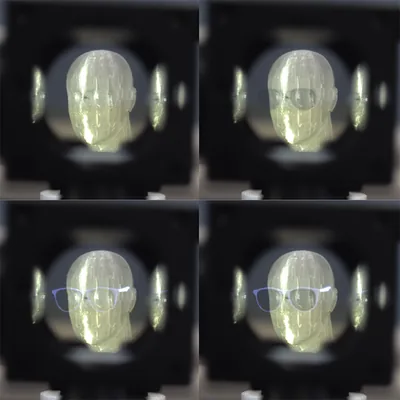 CP13 RAPHO: A Rapid Occluding Photochromic Occlusion Capable See-Through DisplayIn 2025 IEEE International Symposium on Mixed and Augmented Reality Abstracts and Workshops (ISMAR 2025 Poster), Oct 2025
Occlusion capability (OC) has been one of the important topics in designing the next-generation optical see-through near-eye displays (OST NED). OC broadens OST-NED applications including outdoor ones and improves virtual objects’ spatial perception and their perceived realism. However, conventional OC with optoelectronic masks adds bulkiness and visual artifacts in the real-world view. As an emerging direction, photochromic-based occlusion (PO) has the potential to address these issues, yet current implementations have a critical limitation in their response time. In this paper, we provide a real-time PO-OST NED based on fast-response photochromic materials, bringing it one step closer to realizing a lightweight, high transparency, and visual artifact-free occlusion solution.
@inproceedings{ooi2025rapho,
  author = {Ooi, Chun Wei and Hiroi, Yuichi and Hiraki, Takefumi and Itoh, Yuta},
  title = {RAPHO: A Rapid Occluding Photochromic Occlusion Capable See-Through Display},
  booktitle = {2025 IEEE International Symposium on Mixed and Augmented Reality Abstracts and Workshops (ISMAR 2025 Poster)},
  year = {2025},
  volume = {},
  number = {},
  pages = {648--649},
  month = oct,
  doi = {10.1109/ISMAR-Adjunct68609.2025.00133}
}
2024
- IEEE TVCG
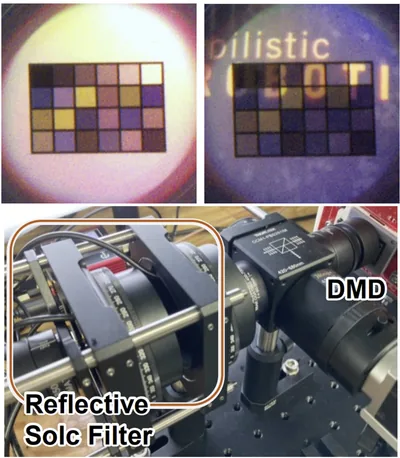 J6 StainedSweeper: Compact, Variable-Intensity Light-Attenuation Display with Sweeping Tunable RetardersYuichi Hiroi, Takefumi Hiraki, and Yuta ItohIEEE Transactions on Visualization and Computer Graphics, May 2024
Light Attenuation Displays (LADs) are a type of Optical See-Through Head-Mounted Display (OST-HMD) that present images by attenuating incoming light with a pixel-wise polarizing color filter. Although LADs can display images in bright environments, there is a trade-off between the number of Spatial Light Modulators (SLMs) and the color gamut and contrast that can be expressed, making it difficult to achieve both high-fidelity image display and a small form factor. To address this problem, we propose StainedSweeper, a LAD that achieves both the wide color gamut and the variable intensity with a single SLM. Our system synchronously controls a pixel-wise Digital Micromirror Device (DMD) and a nonpixel polarizing color filter to pass light when each pixel is the desired color. By sweeping this control at high speed, the human eye perceives images in a time-multiplexed, integrated manner. To achieve this, we develop the OST-HMD design using a reflective Solc filter as a polarized color filter and a color reproduction algorithm based on the optimization of the time-multiplexing matrix for the selected primary color filters. Our proof-of-concept prototype showed that our single SLM design can produce subtractive images with variable contrast and a wider color gamut than conventional LADs.
@article{hiroi2024stainedsweeper, author = {Hiroi, Yuichi and Hiraki, Takefumi and Itoh, Yuta}, journal = {IEEE Transactions on Visualization and Computer Graphics}, title = {StainedSweeper: Compact, Variable-Intensity Light-Attenuation Display with Sweeping Tunable Retarders}, year = {2024}, volume = {30}, number = {5}, pages = {2682-2692}, keywords = {Image color analysis;Optical filters;Filtering algorithms;Light sources;Optical imaging;Optical reflection;Optical polarization;Light attenuation display;see-through display;augmented reality;time-multiplexing;polarized color filter}, doi = {10.1109/TVCG.2024.3372058}, issn = {1941-0506}, month = may, } - IEEE ISMAR
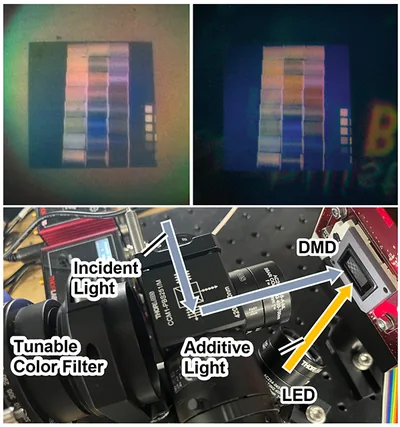 CF9 FactoredSweeper: Optical See-Through Display Integrating Light Attenuation and Addition with a Single Spatial Light ModulatorYuichi Hiroi, Takefumi Hiraki, and Yuta ItohIn 2024 IEEE International Symposium on Mixed and Augmented Reality (ISMAR), Oct 2024
Light Attenuation Displays (LADs), a subset of Optical See-Through Head-Mounted Displays (OST-HMDs), enable image display in bright environments by filtering incident light at the pixel level. Although recent methods have proposed single-DMD light attenuation, they do not consider additive color display and background compensation, limiting their applicability in real-world scenarios. We present FactoredSweeper, a single digital micromirror device (DMD) system that incorporates both light attenuation and addition. By synchronizing the DMD, color filter, and light source, our system generates an additive virtual image, light attenuation, and occlusion through time multiplexing. To produce the target image while compensating for the background, we optimize time-multiplexed binary DMD patterns and LED/color filter schedules using perceptually-driven non-negative matrix factorization. Simulations and prototypes demonstrate that our integrated attenuation-addition single-SLM system achieves superior dynamic range and perceptual image quality compared to conventional occlusion-capable OST-HMDs using grayscale occlusion masks.
@inproceedings{hiroi2024factored,
  author = {Hiroi, Yuichi and Hiraki, Takefumi and Itoh, Yuta},
  title = {FactoredSweeper: Optical See-Through Display Integrating Light
  Attenuation and Addition with a Single Spatial Light Modulator},
  booktitle = {2024 IEEE International Symposium on Mixed and Augmented Reality (ISMAR)},
  year = {2024},
  volume = {},
  number = {},
  pages = {61--70},
  keywords = {Light attenuation display; see-through display; augmented reality, time-multiplexing; perceptual-driven matrix factorization},
  month = oct,
  doi = {10.1109/ISMAR62088.2024.00020},
}
2023
- IEEE VR
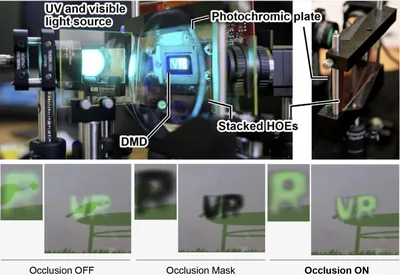 CF6 A Compact Photochromic Occlusion Capable See-through Display with Holographic LensesChun-Wei Ooi, Yuichi Hiroi, and Yuta ItohIn 2023 IEEE Conference Virtual Reality and 3D User Interfaces (VR), Mar 2023
Occlusion is a crucial visual element in optical see-through (OST) augmented reality, however, implementing occlusion in OST displays while addressing various design trade-offs is a difficult problem. In contrast to the traditional method of using spatial light modulators (SLMs) for the occlusion mask, using photochromic materials as occlusion masks can effectively eliminate diffraction artifacts in see-through views due to the lack of electronic pixels, thus providing superior see-through image quality. However, this design requires UV illumination to activate the photochromic mate-rial, which traditionally requires multiple SLMs, resulting in a larger form factor for the system. This paper presents a compact photochromic occlusion-capable OST design using multilayer, wavelength-dependent holographic optical lenses (HOLs). Our approach employs a single digital mi-cromirror display (DMD) to form both the occlusion mask with UV light and a virtual image with visible light in a time-multiplexed man-ner. We demonstrate our proof-of-concept system on a bench-top setup and assess the appearance and contrasts of the displayed image. We also suggest potential improvements for current prototypes to encourage the community to explore this occlusion approach.
@inproceedings{ooi2023photochromic,
  author = {Ooi, Chun-Wei and Hiroi, Yuichi and Itoh, Yuta},
  booktitle = {2023 IEEE Conference Virtual Reality and 3D User Interfaces (VR)},
  title = {A Compact Photochromic Occlusion Capable See-through Display with Holographic Lenses},
  year = {2023},
  volume = {},
  number = {},
  pages = {237-242},
  keywords = {Visualization;Optical diffraction;Three-dimensional displays;Optical design;Prototypes;Holography;User interfaces;Human-centered computing-Human computer interaction (HCI)-Interaction paradigms-Mixed / augmented reality;Human-centered computing-Communication hardware;interfaces and storage-Displays and imagers},
  doi = {10.1109/VR55154.2023.00039},
  issn = {2642-5254},
  month = mar,
}
2021
- Opt. Exp.
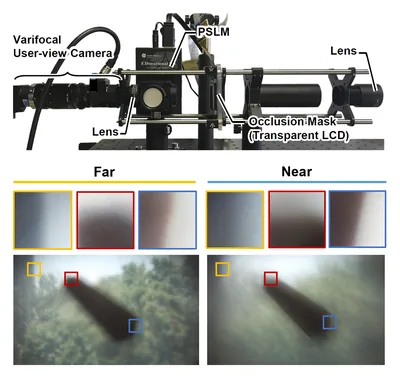 J3 Focal surface occlusionOpt. Express, Oct 2021
This paper proposes focal surface occlusion to provide focal cues of occlusion masks for multiple virtual objects at continuous depths in an occlusion-capable optical see-through head-mounted display. A phase-only spatial light modulator (PSLM) that acts as a dynamic free-form lens is used to conform the focal surface of an occlusion mask to the geometry of the virtual scene. To reproduce multiple and continuous focal blurs while reducing the distortion of the see-through view, an optical design based on afocal optics and edge-based optimization to exploit a property of the occlusion mask is established. The prototype with the PSLM and transmissive liquid crystal display can reproduce the focus blur of occluded objects at multiple and continuous depths with a field of view of 14.6°.
@article{hiroi2021focalsurface,
  author = {Hiroi, Yuichi and Kaminokado, Takumi and Ono, Shunsuke and Itoh, Yuta},
  journal = {Opt. Express},
  keywords = {Head mounted displays; Microlens arrays; Near eye displays; Optical components; Optical systems; Spatial light modulators},
  number = {22},
  pages = {36581--36597},
  publisher = {Optica Publishing Group},
  title = {Focal surface occlusion},
  volume = {29},
  month = oct,
  year = {2021},
  url = {https://opg.optica.org/oe/abstract.cfm?URI=oe-29-22-36581},
  doi = {10.1364/OE.440024},
}
2020
- IEEE TVCG
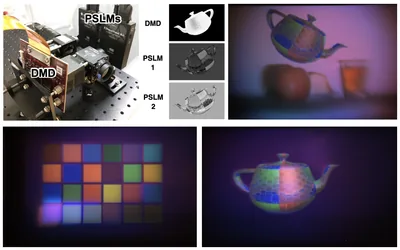 J2 StainedView: Variable-Intensity Light-Attenuation Display with Cascaded Spatial Color Filtering for Improved Color FidelityTakumi Kaminokado, Yuichi Hiroi, and Yuta ItohIEEE Transactions on Visualization and Computer Graphics, Dec 2020
We present StainedView, an optical see-through display that spatially filters the spectral distribution of light to form an image with improved color fidelity. Existing light-attenuation displays have limited color fidelity and contrast, resulting in a degraded appearance of virtual images. To use these displays to present virtual images that are more consistent with the real world, we require three things: intensity modulation of incoming light, spatial color filtering with narrower bandwidth, and appropriate light modulation for incoming light with an arbitrary spectral distribution. In StainedView, we address the three requirements by cascading two phase-only spatial light modulators (PSLMs), a digital micromirror device, and polarization optics to control both light intensity and spectrum distribution. We show that our design has a 1.8 times wider color gamut fidelity (75.8% fulfillment of sRGB color space) compared to the existing single-PSLM approach (41.4%) under a reference white light. We demonstrated the design with a proof-of-concept display system. We further introduce our optics design and pixel-selection algorithm for the given light input, evaluate the spatial color filter, and discuss the limitation of the current prototype.
@article{kamino2020stainedview, author = {Kaminokado, Takumi and Hiroi, Yuichi and Itoh, Yuta}, journal = {IEEE Transactions on Visualization and Computer Graphics}, title = {StainedView: Variable-Intensity Light-Attenuation Display with Cascaded Spatial Color Filtering for Improved Color Fidelity}, year = {2020}, volume = {26}, number = {12}, pages = {3576-3586}, keywords = {Image color analysis;Optical imaging;Optical polarization;Adaptive optics;Optical distortion;Optical modulation;Nonlinear optics;Light attenuation display;phase modulation;see-through display;vision augmentation;augmented reality}, doi = {10.1109/TVCG.2020.3023569}, issn = {1941-0506}, month = dec, } - Augmented Humans
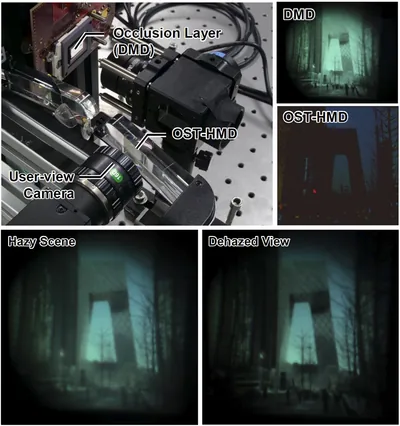 CF2 DehazeGlasses: Optical Dehazing with an Occlusion Capable See-Through DisplayYuichi Hiroi, Takumi Kaminokado, Atsushi Mori, and Yuta ItohIn Proceedings of the Augmented Humans International Conference, Kaiserslautern, Germany, Mar 2020
We present DehazeGlasses, a see-through visual haze removal system that optically dehazes the user’s field of vision. Human vision suffers from a degraded view due to aspects of the scene environment, such as haze. Such degradation may interfere with our behavior or judgement in daily tasks. We focus on hazy scenes as one common degradation source, which whitens the view due to certain atmospheric conditions. Unlike typical computer vision systems that process recorded images, we aim to realize a see-through glasses system that can optically manipulate our field of view to dehaze the perceived scene. Our system selectively modulates the intensity of the light entering the eyes via occlusion-capable optical see-through head-mounted displays (OST-HMD). We built a proof-of-concept system to evaluate the feasibility of our haze removal method by combining a digital micromirror device (DMD) and an OST-HMD, and tested it with a user-perspective viewpoint camera. A quantitative evaluation with 80 scenes from a haze removal dataset shows that our system realizes a dehazed view that is significantly closer to the ground truth scene compared to the native view under a perceptual image similarity metric. This evaluation shows that our system achieves perceptually natural haze removal while maintaining the see-through view of actual scenes.
@inproceedings{hiroi2020dehaze,
  pages = {1--11},
  month = mar,
  author = {Hiroi, Yuichi and Kaminokado, Takumi and Mori, Atsushi and Itoh, Yuta},
  title = {DehazeGlasses: Optical Dehazing with an Occlusion Capable See-Through Display},
  year = {2020},
  isbn = {9781450376037},
  publisher = {Association for Computing Machinery},
  address = {New York, NY, USA},
  url = {https://doi.org/10.1145/3384657.3384781},
  doi = {10.1145/3384657.3384781},
  booktitle = {Proceedings of the Augmented Humans International Conference},
  articleno = {3},
  numpages = {11},
  keywords = {Vision Augmentation, Occlusion-Capable HMD, Head-Mounted Displays, Haze Removal, Augmented Reality},
  location = {Kaiserslautern, Germany},
  series = {AHs '20},
}
2017
- Augmented Human
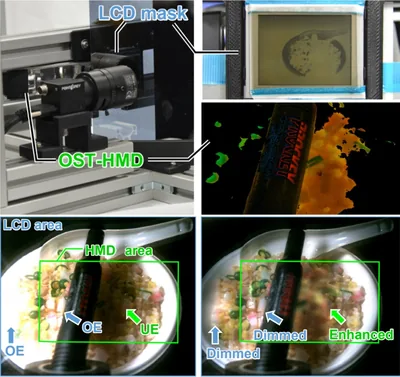 CF1 AdaptiVisor: assisting eye adaptation via occlusive optical see-through head-mounted displaysYuichi Hiroi, Yuta Itoh, Takumi Hamasaki, and Maki SugimotoIn Proceedings of the 8th Augmented Human International Conference, Silicon Valley, California, USA, Mar 2017Best paper Best Paper, 3rd Place, Augmented Human 2017.
Brightness adaptation is a fundamental ability in human visual system, and adjusts various levels of darkness and light. While this ability is continuously used, and it can mostly handle sudden lighting changes in the environment, the adaptation could still take several minutes. Moreover, during the adaptation, the color perception changes as well. This slow reactivity and perception change of the eyes could lead to mistakes for tasks performed in dazzling or temporally high-contrast environments such as when driving into the sun or during a welding process.We present AdaptiVisor, a vision augmentation system that assists the brightness adaptation of the eye. Our system selectively modulates the intensity of the light coming into the eyes via occlusion-capable Optical See-Through Head-Mounted Displays (OST-HMD). An integrated camera captures highlights and brightness in the environment via high-dynamic range capture, and our display system selectively dims or enhances part of field of views so that the user would not perceive rapid brightness changes. We build a proof-of-concept system to evaluate the feasibility of the adaptation assistance by combining a transmissive LCD panel and an OST-HMD, and test it with a user-perspective, view-point camera. The evaluation shows that the system decreases the overexposed area in a scene to 1/15th, and enhances the color by reducing majorly underexposed area to half. We also include a preliminary user trial and it indicates that the system also works for real eyes for the HMD part and to some extent for the LCD.
@inproceedings{hiroi2017adaptivisor,
  pages = {1--9},
  month = mar,
  author = {Hiroi, Yuichi and Itoh, Yuta and Hamasaki, Takumi and Sugimoto, Maki},
  title = {AdaptiVisor: assisting eye adaptation via occlusive optical see-through head-mounted displays},
  year = {2017},
  isbn = {9781450348355},
  publisher = {Association for Computing Machinery},
  address = {New York, NY, USA},
  url = {https://doi.org/10.1145/3041164.3041178},
  doi = {10.1145/3041164.3041178},
  booktitle = {Proceedings of the 8th Augmented Human International Conference},
  articleno = {9},
  numpages = {9},
  keywords = {AdaptiVisor, augmented reality, brightness adaptation, head-mounted displays, near-eye displays, occlusive HMD, optical see-through, vision augmentation},
  location = {Silicon Valley, California, USA},
  series = {AH '17},
}